
Branded logos no longer command the attention they once did in the B2B landscape; instead, people’s voices are attended to more. Their opinions and insights drive buying decisions. And B2B buyers have become highly selective about who they listen to, with 92% of B2B buyers stating they trust employee recommendations over traditional corporate advertising. Moreover, content shared by people achieves 8 times the engagement than the same message published by a corporate brand account.
In such a scenario where personal profiles consistently outperform corporate pages in reach and conversion, more and more B2B organizations are choosing employee advocacy programs to boost their marketing efforts.
However, marketing leaders need to take a decision right at the start: Manage the advocacy program manually, or automate it?
Let’s look at the numbers, analyze the bottlenecks, and understand what actually delivers more when you pit manual processes against advocacy automation.
A manual employee advocacy program usually starts out with the right motivations. A marketeer will curate a list of ‘shareable links’ once a week and paste them into a Slack channel, an email newsletter, or a shared Google Sheet, instructing the rest of the team to pick and post from there.
This approach is seemingly authentic. There are no bots, and every message is curated personally. But when it comes to growth, manual advocacy does not yield the desired effect. It falls through due to three specific challenges:
Manual programs typically stagnate at a handful of shares by executive participants. For a global enterprise or a fast-growing SaaS business, this approach fails to make any impact in the brand visibility.
To turn employee advocacy into a predictable growth channel, it must be treated like any other high-performing engine in the MarTech stack. Just as marketing automation b2b tools revolutionized lead nurturing, dedicated advocacy technology streamlines the logistics of organic social distribution.
Organizations that transition to automated advocacy structures gain distinct, measurable performance advantages across their funnels:
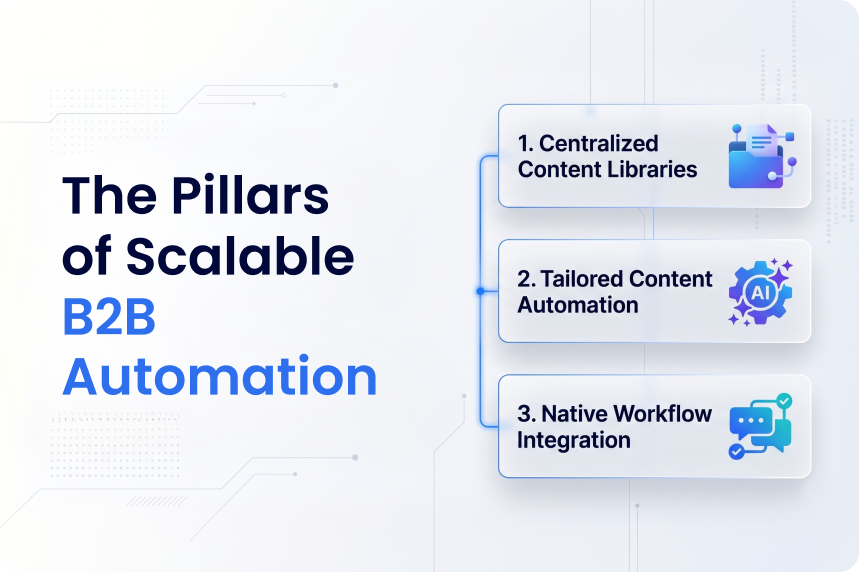
Advocacy software scales because it systematically removes the blockers that fails manual initiatives, through its three main features.
1. Centralized Content Libraries
Automated platforms serve as a consolidated content hub where marketeers can upload pre-approved company updates, industry news, and behind-the-scenes of workspace. Employees can log in, select a category relevant to their personal brand, and share it in just a few clicks, instead of searching through spreadsheets.
2. Tailored Content Automation
Drafting a caption from scratch can be really tedious for employees. Modern advocacy platforms solve this by using content automation to provide pre-written text variations for every link. Advanced systems even deploy integrated AI assistants to suggest personalized captions, allowing employees to change the tone of voice into their own instantly.
3. Native Workflow Integration
Shuffling to a completely separate web app in between daily tasks just to share a post limits the adoption of the advocacy program. When the program meets employees where they already work it is more prone to be adopted. Modern advocacy platforms integrate directly into daily internal tools like Slack and Microsoft Teams. Employees can view, approve, and push a LinkedIn post directly out of a standard notification channel without breaking their daily workflow.
[Marketer Uploads Link] ➔ [Content Automation Drafts 3 Captions] ➔ [Slack/Teams Push Notification] ➔ [Employee Shares in 1 Click]
While automation provides the infrastructure to scale, over-automation can risk garnering the ‘corporate clone’ effect. If 100 employees post the exact same text and graphic simultaneously, the LinkedIn algorithm will flag the posts and the reach will plummet.
For true growth finding the right balance between system efficiency and human authenticity is a must. To get the best out of your software investment:
Manual advocacy does a good job as a beta test for a small leadership team. But if you’re looking to expand your brand's share of voice, reduce your cost-per-lead, and empower your entire team to become modern social sellers, advocacy automation is the only path forward.
Considering employee voices as an integral part of your marketing automation b2b strategy, you can dodge the operational roadblocks, unlock concrete attribution data, and turn your workforce into your most powerful marketing channel.


Insights around Employee-led Distribution + Growth every 2 weeks

The modern employee advocacy platform. Turn your team into your most trusted marketing channel.