

.png)
.png)
Traditional B2B marketing is not as effective as it once used to be. With rising corporate ad costs and audiences growing wary of company pages, corporate broadcasting is becoming more and more inert. A vast majority of B2B marketeers agree that building trust is now the single most important driver for brand success.
And at a time when buyers are no longer swayed by corporate marketing your workforce can be a gamechanger when it comes to building trust. A structured employee branding strategy can scale your pipeline, reduce your customer acquisition costs, and create influence far beyond what a paid ad campaign ever can.
For years, B2B brands have worked intensively into building their company pages. However, LinkedIn’s algorithm is fundamentally built to reward peer-to-peer human interaction.
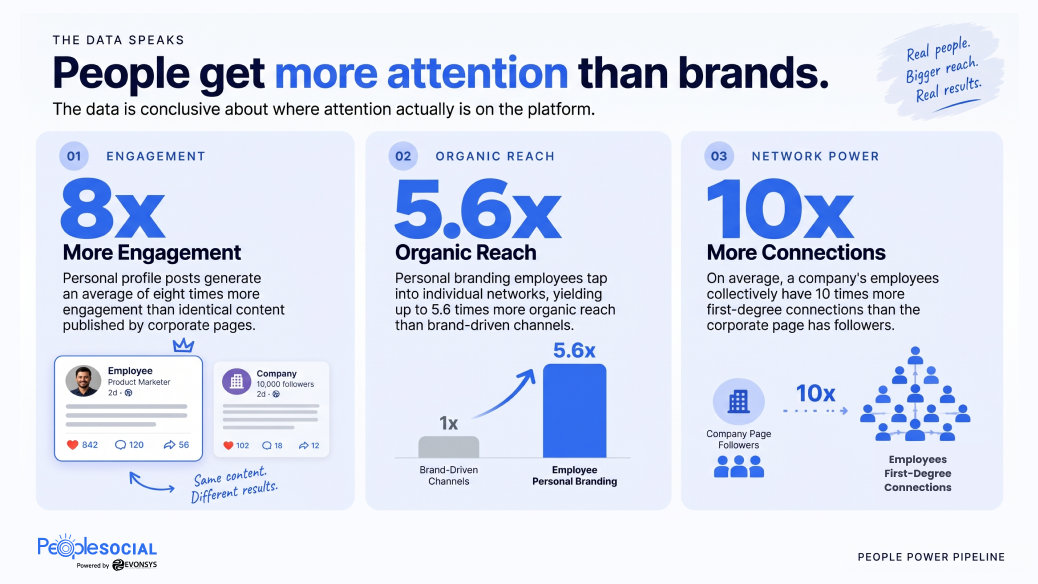
If a corporate page has 10,000 followers, its organic posts usually reach only a tiny fraction of that base due to algorithm throttling. But if 50 employees have 3,000 connections each, the employer brand suddenly gains a collective network of 150,000 industry professionals. That is a 15x distribution multiplier harnessed entirely by authentic human voices.
The ultimate goal of LinkedIn branding shouldn’t be just about scoring high in vanity metrics like likes or impressions; it is about building revenue-generating pipeline. As the modern B2B customer journey is longer and more complex than ever credibility needs to be established right at the start.
92% of B2B buyers trust recommendations from individual employees over traditional, corporate advertising.
When your subject matter experts, analysts, and product managers regularly share insights and opinions, it, in turn, unveils your organization's expertise. This shift dramatically expedites the sales cycle. Leads sourced directly through employee advocacy conversion paths see a 7x higher visitor-to-lead conversion rate than standard cold traffic.
Moreover, prospects are 27% more likely to respond to direct business outreach like InMails when they relate to a brand's actual employees.
A high-performing employee branding strategy requires structure, because ad hoc initiatives run cold quickly. Only 3% of employees typically share company content voluntarily. To bridge this gap and activate your team, focus on these three foundational pillars:
1. Shift from Corporate Dictation to Personal Autonomy
When employees are required to copy and paste rigid, pre-written corporate posts, the whole strategy fails in the very beginning. Modern audiences are highly sensitive to stereotype company content, and the LinkedIn algorithm actively penalizes repetitive text. In fact, interchangeable or automated posts experience a 10% to 14% drop in reach compared to original human copy.
Enable your team with ‘content prompts’ or structural frameworks. This will allow them to blend their own perspective, voice, and daily experiences into the post.
2. Prioritize Value-first Content Formats
To maximize engagement, align your team's content with what the algorithm—and decision-makers—actually want to consume. Recent performance benchmarks show that PDF carousels yield 51% more reach than standard text-only posts, while brief text updates accompanied by high-quality organic images see steady engagement rates of nearly 3.10%.
External links in the body of a post can reduce total impressions by roughly 13%, as platforms prefer to keep users on-site. Train your employees to leave links in the comments and emphasize text-based storytelling.
3. Instruct and Incentivize
Many employees hesitate to post because of imposter syndrome or a lack of clarity on what is safe to share. Formal training sessions that focus on building a personal brand through social sharing is highly effective in fostering confidence among employees. Show them the mutual benefit of helping to scale the company’s influence, and simultaneously raising their own professional value and thought leadership status.
Investing in your employees' presence on LinkedIn creates a self-sustaining marketing loop. It lowers outbound sales friction, elevates brand awareness, and serves as a undeniable pull for top-tier industry talent.
Your employees can do a lot more than just quietly serving the corporate brand. With a structured employee branding strategy, you transform your workforce into an influential social media network - fuelling an authentic, scalable engine for sustainable B2B growth.
.png)


Insights around Employee-led Distribution + Growth every 2 weeks
.svg)
The modern employee advocacy platform. Turn your team into your most trusted marketing channel.