

.png)
.png)
In B2B marketing buyer decision is no longer based on corporate whitepapers or brand ads. Instead, they choose to go with people’s opinions. According to data from LinkedIn and Ipsos, 55% of B2B marketeers actively use influencer or creator marketing. On the other hand, companies are realizing that their own teams have unutilized marketing clout. This opens up a critical question for growth leaders: employee advocacy vs influencer marketing - which strategy delivers better RoI for B2B brands?
Employee advocacy channelizes the power of your employee network into undeniable brand presence in socials. Engineers to executive leadership, sales to research – everyone gets activated through this to share company updates, industry insights, and work-culture moments on their personal social networks. And the benefits are multiple due to the unmatched, built-in organic reach.
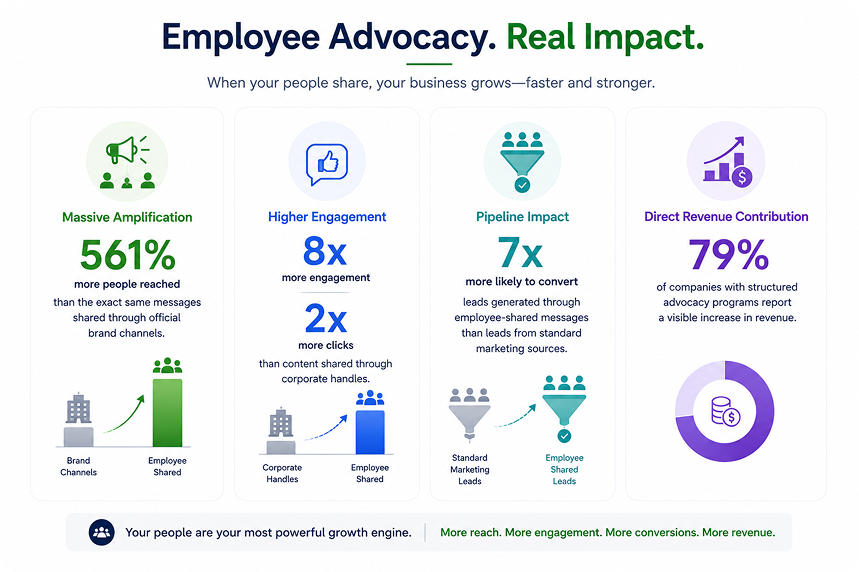
Employee advocacy channelizes the power of your employee network into undeniable brand presence in socials. Engineers to executive leadership, sales to research – everyone gets activated through this to share company updates, industry insights, and work-culture moments on their personal social networks. And the benefits are multiple due to the unmatched, built-in organic reach.
Unlike the consumer space, which relies on lifestyle creators, b2b influencer marketing focuses on industry analysts, consultants, thought leaders, and veteran executives. These are individuals who have spent years building dedicated, niche audiences.
B2B influencer marketing is currently the fastest-growing subcategory in the creator landscape, expanding at a massive 47% year-over-year rate to a market size of $4.1 billion. (https://www.digitalapplied.com/blog/influencer-marketing-statistics-2026-data-points )
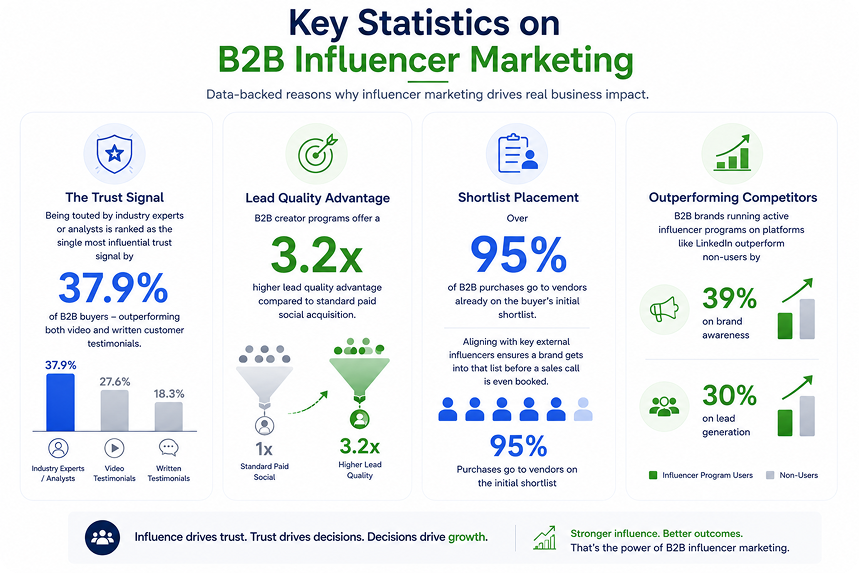
The objective, third-party validation that can pull in a hesitant C-suite buyer is the speciality of external influencers which employees rarely have.
To choose the right approach for your budget, it is important to understand how these channels stack up across core marketing performance indicators:
The answer depends entirely on immediate business objectives and the stage in which the brand’s digital footprint is in.
Choose Employee Advocacy if your primary goal is lowering CAC and driving conversions
If you have a large workforce but low organic reach, building an internal program is the option that brings you the highest RoI. It capitalizes on the company culture to start a reliable lead generation engine. The cost per lead also drops significantly due to the cutting down of external creator fees, thus maximizing bottom-line margins.
Choose B2B Influencer Marketing if your primary goal is category creation or account penetration
If you are launching a new enterprise SaaS product or trying to break into a brand-new vertical, your employee networks might not reach the right decision-makers. With an expert endorsement your company gains immediate authority. Expert voices are way more likely to give your brand a competitive edge than any self-published corporate content.
It’s not a matter of choice between employee advocacy and influencer marketing. Successful B2B brands combine them. In fact, a large number of B2B companies strategize their executive and employee advocacy initiatives as part of their wider influencer-led marketing outreach.
By using external creators to capture top-of-the-funnel awareness and utilizing your internal employees to carry those leads through the middle of the funnel, you build a comprehensive ecosystem of trust that drives sustainable B2B revenue.
Want to know about how to scale through employee advocacy with the least friction?
.png)


Insights around Employee-led Distribution + Growth every 2 weeks
.svg)
The modern employee advocacy platform. Turn your team into your most trusted marketing channel.





.png)