

.png)
.png)
In today’s B2B ecosystem the corporate logo doesn’t have the same clout as it used to. The average consumer is more well informed than ever and the advertisement campaigns worth millions can’t shape their perception of brands like before.
This shift has generated two influential concepts: Employee Advocacy and Employee-led Growth (ELG). While they sound like corporate catchwords born under same circumstances, they essentially represent 2 different concepts of how a business interacts with the market.
Let's dig deeper into the employee advocacy vs employee led growth discourse, with all the conclusive data you need to justify your next marketing budget.
Employee Advocacy is the promotion of an organization by its workforce. The organization creates a content - be it a blog post, a product launch video, a meme, or a User Generated Content - and asks employees to share it on their personal social networks.

However, employee advocacy can seem staged. If 50 employees share identical pre-written caption on LinkedIn at the same date and time, the audience will deduce a ‘mandate’ out of this effort, not an honest opinion.
If advocacy is a ‘top-down’ loudspeaker, Employee-led Growth (ELG) is a conversation. ELG is a "bottom-up" methodology where employees are empowered to build their own personal brands and voice within their niche, which naturally rubs off on the employer-company during the development.
In ELG, employees aren't just distributors; they are creators. This is at the epicentre of the modern employee marketing model.
Key Differences
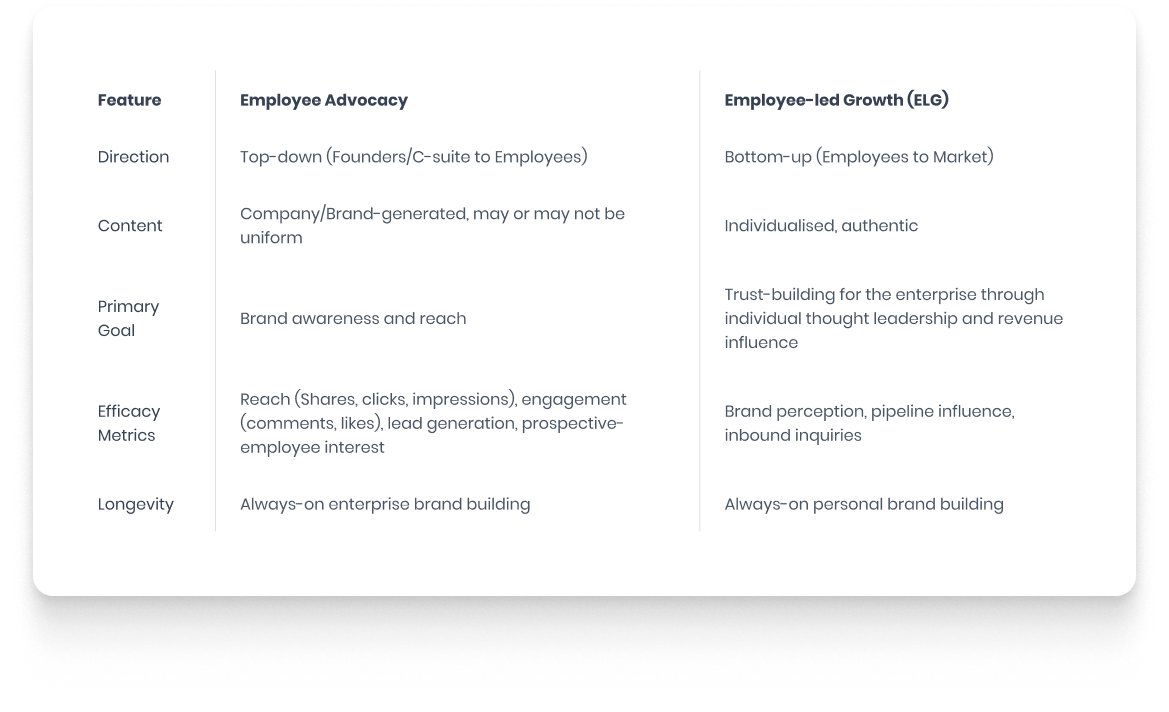
1.Adobe: The Great ‘Advocacy’ Advocate
Adobe’s "Social Shift" program is a masterclass in the employee advocacy strategy. They provide employees with specialized training and a centralized platform, Adobe Life, to post behind-the-scenes content.
2. Gong: The ELG Powerhouse
Gong, the revenue intelligence platform, encouraged its salespeople to become ‘Sales Influencers.’ Reps like Sarah Brazier built massive personal followings by sharing genuine, unfiltered sales advice. As a result, Gong became synonymous with ‘sales mastery’ and their employees became the chief initiators of inbound demo requests.
From badgering employees to repost to driving revenue through people – every company needs a structured employee marketing model. Here is the three-pillar framework that yields the highest ROI:
1. The ‘Incentive over Mandate’ Principle
Social sharing should not be compulsory; instead, employees should be incentivised to do so.
2. Strategic Enablement
‘Content Pillars’ instead of copy-paste captions goes a long way in giving voice to an employee’s expertise and experience. A DevOps engineer will do better in talking about the future of Kubernetes, not just about his/her employer’s latest software patch. Also in this regard, employees should be enabled with professional headshots, LinkedIn profile audits, and access to industry data.
3. Measurement Beyond "Likes"
To understand what actually works, ‘shares’ should not be regarded as the foremost metric. Instead, it’s important to track:
It isn't a binary choice between employee advocacy vs employee led growth.
Employee Advocacy is great for a broader reach to garner a positive perception about the brand, thereby leading to customer and talent acquisition. It’s the foundation on which the employer brand can grow exponentially.
Employee-led Growth, on the other hand, is a brand’s competitive edge. It drives high-ticket B2B sales and long-term industry authority. According to LinkedIn, employees have 10 times more followers than their corporate accounts, and their posts are reshared 24 times more frequently.
If you want your brand to command in 2026, start thinking of your employees as an undeniable network of subject matter experts and brand advocates.
.png)


Insights around Employee-led Distribution + Growth every 2 weeks
.svg)
The modern employee advocacy platform. Turn your team into your most trusted marketing channel.