

.png)
.png)
Historically employee advocacy was seen as a dispensable internal initiative - a way to amplify company announcements or boost employer branding. But in today's landscape, it has changed into a high-yield growth engine.
As traditional paid advertising channels face rising costs, modern marketing and sales leaders are turning to one of their most valuable asset - their employees.
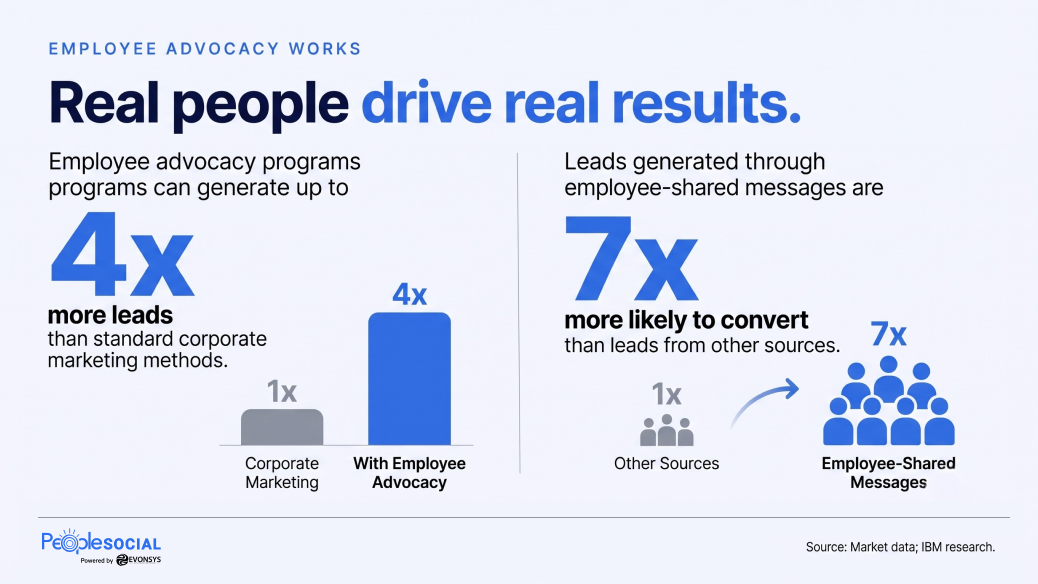
When employees share content, they are not just following a marketing tactic; they are building trust among audiences old and new. The Edelman Trust Barometer highlights that people consistently put higher trust in regular employee posts than in content from corporate entities.
If your organization wants to move beyond vanity metrics like ‘likes’ and superficial ‘comments’ you must focus on the key outcomes. Here is how to track employee advocacy ROI, calculate social selling ROI, and critically understand the advocacy metrics that impact pipeline, revenue, and Customer Acquisition Cost (CAC).
To accurately measure how employee advocacy contributes to your sales pipeline, you must establish clear tracking parameters, such as unique UTM links for each employee and CRM tags for social interactions. This way you can divide your pipeline into two core categories:
Data from LinkedIn indicates that active social sellers generate 78% more opportunities than non-social sellers. When evaluating your pipeline, look for a drop in your average sales cycle length. Organizations using social selling strategies frequently see a 20% to 30% reduction in sales cycle times, as peer trust nullifies traditional top-of-funnel friction.
In order to measure the financial return of an advocacy program linking social participation directly to closed-won deals is essential.
.png)
To calculate your program's exact revenue contribution, use this straightforward formula:
Employee Advocacy ROI (%)=(New Revenue Sourced from Advocacy−Total Program CostTotal Program Cost)×100Employee Advocacy ROI (%)=New Revenue Sourced from Advocacy−Total Program CostTotal Program Cost×100
What to include in Total Program Cost:
Mark your revenue data against employees’ social activities as you evaluate your sales force. High social performers typically gain higher quota. According to LinkedIn Social Selling Index (SSI) data, sales professionals with a high SSI score are 51% more likely to reach their quotas than their low-social peers.
Customer Acquisition Cost is one of the most highly scrutinized metrics in business. Employee advocacy acts as an efficient counterweight to expensive paid acquisition by transforming employee networks into organic distribution channels. Content shared by employees reaches 561% more people than the exact same messages shared through official corporate brand channels. This huge reach of organic efforts reduces dependency on paid media networks significantly.
By doubling conversion rates and cutting cost-per-lead by half, employee advocacy lowers overall CAC immediately. Instead of paying continuous ad network fees for impressions, your investment in software and employee enablement scales exponentially over time without extra ad spend.
For the executive leadership to have complete grasp of RoI, your reporting dashboard should focus entirely on financial outcomes, leaving vanity metrics aside. Ensure your marketing and revenue teams monitor these key advocacy metrics:
Sourcing & Conversion Metrics
Financial Efficiency Metrics
.png)


Insights around Employee-led Distribution + Growth every 2 weeks
.svg)
The modern employee advocacy platform. Turn your team into your most trusted marketing channel.