New
PeopleSocial’s 2026 Employee-Led Distribution Playbook is live
Peoplesocial logo
EnterprisePricing
New
PeopleSocial’s 2026 Employee-Led Distribution Playbook is live
Peoplesocial logo
Hamburger menu iconClose
12 Best Employee Advocacy Tools for B2B in 2026

12 Best Employee Advocacy Tools for B2B in 2026

Profile Icon
Author
October 28, 2026

Introduction

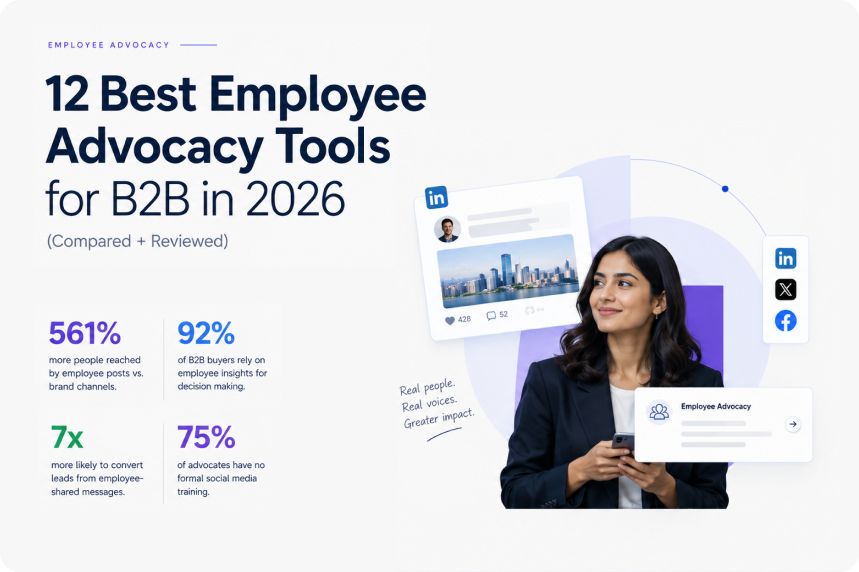
The B2B organic marketing landscape has changed drastically. With rising paid ad costs and algorithms increasingly prioritizing individual voices over cold corporate pages, old strategies are not being as effective as it once used to be. In fact, corporate posts struggle for reach, while employees individually reach 561% more people than official brand channels.  

B2B buyers look for genuineness. Data shows that 92% of B2B buyers rely on employee insights for decision making and leads generated through employee-shared messages are 7x more likely to convert than leads from other sources.  

To utilize this immense pipeline potential, organizations are keeping spreadsheets aside and adopting dedicated software. Since 75% of employee advocates have no formal social media training, using a structured employee advocacy platform helps hugely to enable them.

Here is an analytical comparison and review of the 12 best employee advocacy tools dominating B2B in 2026.
2026 Top Employee Advocacy Tools at a Glance

Platform Best For Core Strength Key Integration
Sharebee All-in-One B2B Seamless LinkedIn partnership and sharing Slack, MS Teams
Sociabble Global Enterprise High-scale gamification and CSR rewards Salesforce, Workday
DSMN8 Automation-First Teams Campaign-driven auto-sharing Slack, Microsoft Teams
EveryoneSocial Regulated Industries Multi-tier compliance and governance HubSpot, Salesforce
Oktopost B2B Social Selling Granular B2B pipeline attribution Marketo, HubSpot
GaggleAMP High Participation Actions Email-to-social activation Salesforce, HubSpot
Taplio Founders and Small Teams AI-powered LinkedIn growth engine Native LinkedIn CRM
Haiilo Internal Comms Focus Merging internal messaging with advocacy SharePoint, MS Teams
Sprout Social Add-on Users Unified social management suite Native Sprout Analytics
Hootsuite Amplify Social Media Teams Risk management and scheduling at scale Native Hootsuite Dashboard
Clearview Social Professional Services Single-click email listings for legal and finance Major CRM Platforms
Ambassify Dual Advocacy Combining customer and employee advocacy Custom Webhooks

‍

Deep Dive Reviews: The 12 Best Platforms

1.Sharebee

Sharebee has quickly risen to become a top choice for modern B2B organizations in 2026. It strikes a nice balance between employer branding and individual creator success. It drives employees to write like humans, to bypass corporate feed spam.

  • Standout Feature: AI-powered content aid that sets personalized contexts for employees, thus preventing writer's block
  • Pros: Exceptional UI/UX that leads to higher adoption rates; robust multi-channel tracking.
  • Cons: Relatively new compared to older legacy platforms

2. Sociabble

Built specifically for massive enterprise ecosystems, Sociabble focuses on scaling engagement through advanced gamification.  

  • Standout Feature: CSR Integration - Employees earn points for sharing corporate content, which they can convert into real-world rewards, such as planting trees.
  • Pros: Multi-language support and hyper-targeted internal communications segmentation
  • Cons: Learning-intensive administrative backend

3. DSMN8

If your marketing department wants maximum control with minimum employee friction, DSMN8 is the go-to option. It is an automation-first advocacy software built for speed.  

  • Standout Feature: ‘Delegate Access’ - allowing marketing managers to securely queue and publish content on behalf of busy C-suite executives.
  • Pros: Effective scheduling automation generating brand visibility quickly
  • Cons: Over-automation can occasionally make employee feeds look mechanical, if not closely monitored.

4. EveryoneSocial

EveryoneSocial is an enterprise-grade advocacy platform, built for highly regulated sectors like finance, healthcare, and tech.  

  • Standout Feature: Multi-level moderation workflows that ensure every post complies with corporate legal standards before reaching social networks
  • Pros: Elite security protocols, custom access permissions, and deep CRM connections
  • Cons: The compliance-first design can sometimes offset real-time engagement

5. Oktopost

Oktopost handles employee advocacy not just as a visibility tactic, but as a genuine revenue driver. It provides distinct pipeline and revenue attribution.

  • Standout Feature: Deep marketing automation sync (Marketo, HubSpot) that aligns individual employee shares directly to lead creation and revenue data.
  • Pros: Exceptional analytics for B2B social selling teams
  • Cons: Interface biased toward data analysts, less user-friendly for standard employees.

6. GaggleAMP

GaggleAMP approaches advocacy through structured execution. Instead of asking employees to find things to say, it shows them a path of specific ‘activities’.

  • Standout Feature: Email-to-Social workflow in which employees can complete specific engagement tasks (for e.g. liking a specific executive's post) straight from their inbox.  
  • Pros: Incredibly high participation rates for non-technical workforces
  • Cons: Lack of creative flexibility that top-tier social sellers prefer

7. Taplio

Taplio is a LinkedIn-specific platform highly focusing on small-to-mid market B2B companies, executive leadership circles, and individual corporate influencers.

  • Standout Feature: An advanced relationship-management module built directly alongside AI generation tools to turn comments into warm leads
  • Pros: Hyper-optimized for LinkedIn's 2026 algorithm layout
  • Cons: Strictly limited to LinkedIn; does not support multi-channel corporate campaigns.

8. Haiilo

Haiilo bridges the gap between top-down internal corporate communications and external employee advocacy.  

  • Standout Feature: Unified internal social feed that integrates easily into an external social sharing platform
  • Pros: Hugely reducing tech stack bloat by combining internal comms and advocacy software
  • Cons: Seemingly superficial analytics compared to social attribution tools

9. Employee Advocacy by Sprout Social

For marketing groups already using Sprout Social for corporate accounts, this native add-on creates a single, unified source of information.  

  • Standout Feature: Shared asset library that lets social media managers craft content for the brand page and send it to the employee advocacy board simultaneously
  • Pros: No separate platform to purchase and learn for existing Sprout users
  • Cons: Lacks specialized personal branding features for employee creators

10. Hootsuite Amplify

Similar to Sprout, Amplify acts as the advocacy platform of the traditional Hootsuite dashboard, emphasizing risk management and brand safety.

  • Standout Feature: Pre-approved content streams categorized by department, location, or domain
  • Pros: Trusted enterprise security architecture
  • Cons: Dated user interface compared to newer, creator-first platforms

11. Clearview Social

Clearview Social is uniquely designed for professional service businesses - such as law firms, accounting practices, and consulting agencies.  

  • Standout Feature: ‘PeakTime’ scheduling, which uses machine learning to automatically leave time gaps between employee shares for the highest possible CTR
  • Pros: Easy sharing for busy professionals who only have 5 minutes a week
  • Cons: Lack of gamification and robust social listening options

12. Ambassify

Ambassify expands the scope of standard programs by allowing organizations to manage and leverage customer advocates alongside their employees.  

  • Standout Feature: Dual-sided community builder that unifies internal teams and external superfans for brand amplification
  • Pros: Excellent for holistic brand-building initiatives
  • Cons: Highly complex if used as an internal employee program only

‍

Conclusion: The 2026 ROI Reality

The benefits of deploying a dedicated advocacy platform are quick. Companies using structured software experience an average 50% drop in cost-per-lead (CPL) and up to a 30% reduction in sales cycle length.  

While choosing your platform, prioritize user experience. If the software is difficult to use participation will be limited, thus wasting the platform's potential. Also, opt for the platform that aligns the most with your team's existing workflow – be it Slack, Teams, or email, and unlock the power of your team’s voice.
‍

You might also like

10 Employee Advocacy Examples in B2B SaaS That Actually Drive Pipeline

10 Employee Advocacy Examples in B2B SaaS That Actually Drive Pipeline

In the highly aggressive B2B SaaS market, the way buyers make decisions has changed significantly. Old ways like gated white papers, cold email campaigns, and standard brand announcements are losing their effectiveness. Today, potential customers trust real people more than they trust sophisticated corporate logos.
Read more
Enjoyed the blog? Share them with your peers!
Share on X (Twitter)Linkedin IconFacebook IconEmail IconWhatsapp Icon

Join our weekly digest

Insights around Employee-led Distribution + Growth every 2 weeks

Peoplesocial logo
© 2026 PeopleSocial. All rights reserved.
close icon1M+ organic impressions playbook promotional banner